Lifting Conveyor Belt for Packaging-Line Transfer
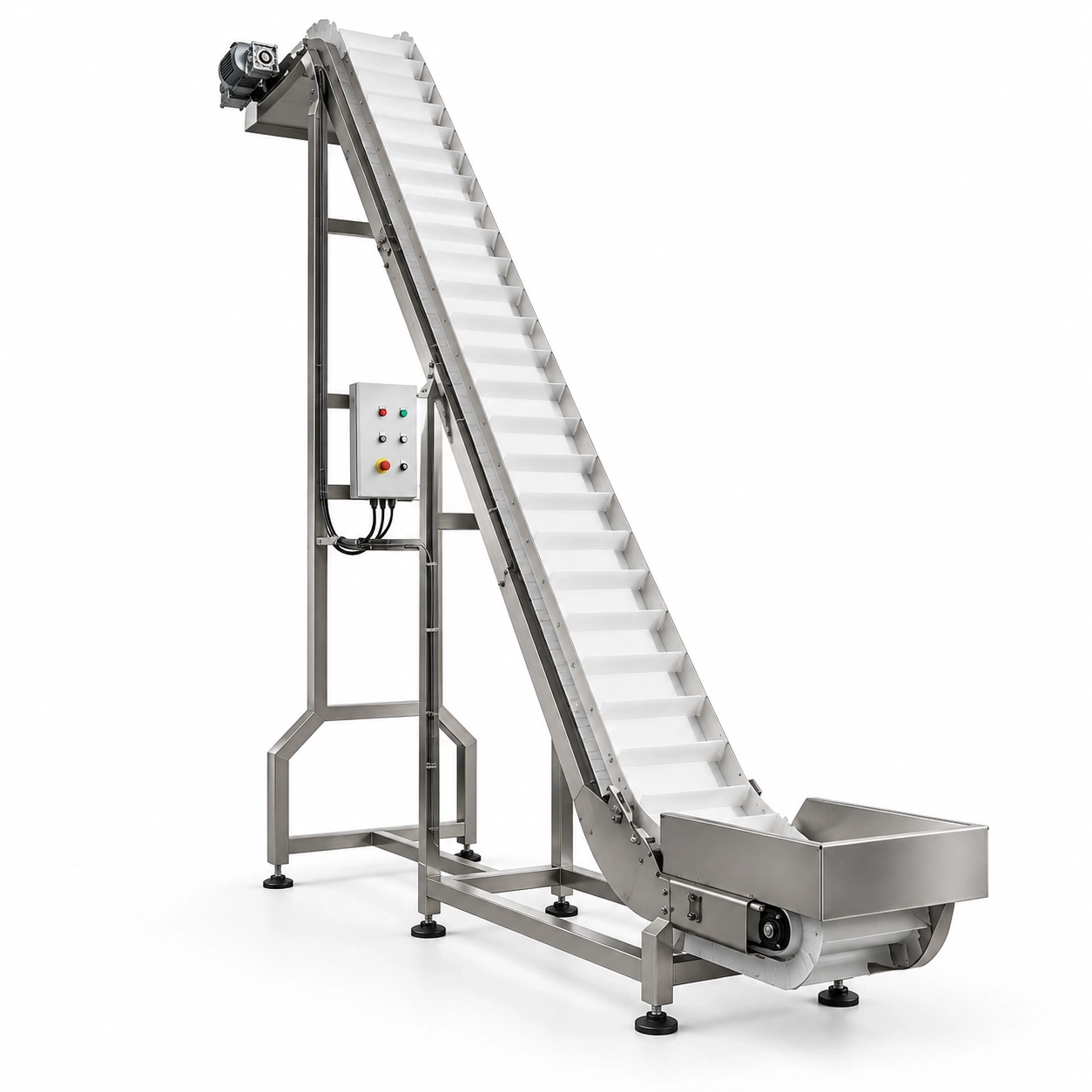
A Lifting Conveyor Belt connects suitable products or materials between lower and elevated working positions in a packaging line. Rather than treating a conveyor as an isolated item, the layout can be considered as one link between feeding, processing and receiving equipment. This Lifting Conveyor Belt is documented with a 304 stainless steel construction and selectable transport-surface options, creating a practical starting point for lines that need an inclined transfer path. The correct configuration depends on the material being conveyed, the loading and discharge points, and the equipment that receives the product.
The Lifting Conveyor Belt is intended to move materials upward where repeated manual lifting is undesirable or where stations operate at different heights. It can be placed between material preparation, filling, weighing or other packaging stages when the product and transfer conditions are suitable. A conveyor route should match the available footprint and the handoff at each end. Put simply, the conveyor choice is only part of the decision; the infeed, discharge and surrounding equipment need to work together.
Documented Specifications
| Item |
Documented specification |
| Machine material |
304 stainless steel |
| Overall width |
400 mm |
| Belt width |
340 mm |
| Lifting capacity |
4,000 L/hour |
| Voltage |
220 V / 380 V |
| Power |
1 kW |
These documented figures describe the Lifting Conveyor Belt supplied for this product page. The 400 mm overall width and 340 mm belt width help define the available transfer area, while the listed 4,000 L/hour capacity provides a reference for early line discussion. Actual suitability depends on the product form, loading method and incline arrangement. Voltage is listed as 220 V or 380 V, and the documented power is 1 kW. Please confirm the project electrical supply and layout before final configuration.
Selectable Conveyor Surfaces
The Lifting Conveyor Belt has four listed transport-surface selections: PVC chain plate, PVC/PU belt, 304 stainless steel mesh chain and 304 stainless steel chain plate. These are selectable options rather than a statement that every surface is supplied on one machine. A PVC/PU belt may suit some material-transfer conditions, while a chain-style surface may be more appropriate where product contact, grip, cleaning or support requirements differ. The conveyed item, its dimensions, its tendency to slide and its cleaning needs should guide the surface discussion.
-
304 stainless steel frame: documented construction for the conveyor body.
-
Surface choice: listed PVC and stainless steel belt or chain alternatives for project discussion.
-
Height transfer: designed to bridge lower and elevated stations for suitable materials or products.
-
Specified electrical options: 220 V or 380 V with 1 kW documented power.
-
Line-focused layout: feeding height, discharge height and receiving equipment can be considered together.
For routine use, operator access to loading, discharge and cleaning areas should be considered during layout planning. The Lifting Conveyor Belt can be matched to the available approach space so that product flow and routine access are addressed together. Where a product is irregular, loose or likely to move on an incline, its handling condition should be reviewed before a surface option is selected.
Use in a Packaging Line
A Lifting Conveyor Belt can serve as a transfer link when a packaging process needs to move material between different working heights. For example, it may connect a lower feed area to an elevated process stage, deliver suitable material toward weighing equipment, or support the flow into a downstream packaging station. Its role is to create a continuous route between stages, subject to the actual product, capacity requirement and receiving-machine conditions.
In an integrated line, the Lifting Conveyor Belt can be discussed alongside downstream equipment such as a piston filling system or a cartoning machine when those machines are part of the planned process. These terms describe possible line interfaces, not included equipment or guaranteed compatibility. The material flow, feed condition, discharge height and control arrangement should be confirmed for the project. A china packaging machine manufacturer can use those application details to discuss how the conveyor may fit a wider packaging layout.
The listed 4,000 L/hour capacity is useful for preliminary conversation, but it should not be read as a universal result for every conveyed material. Flow can be affected by product shape, bulk behavior, loading consistency and the selected surface. A smooth belt and a chain surface offer different contact conditions, so the more suitable choice depends on the actual transfer task. This Lifting Conveyor Belt is therefore best specified with the conveyed product and the adjacent equipment in view.
Configuration Discussion and Inquiry
To discuss a Lifting Conveyor Belt configuration, share the material or product to be conveyed, the feed and discharge heights, expected transfer requirement, available installation space and the machine that receives the product. These details help define whether the documented width, surface options and electrical configuration suit the line. They also help clarify the routing between preparation, filling, weighing, cartoning or other packaging steps.
The product page documents a 304 stainless steel Lifting Conveyor Belt with 400 mm overall width, 340 mm belt width, 4,000 L/hour listed lifting capacity, 220 V or 380 V options and 1 kW power. It also identifies PVC chain plate, PVC/PU belt, stainless steel mesh chain and stainless steel chain plate as available surface selections. Send your product-handling requirements to discuss a conveyor arrangement that fits the required transfer path and packaging-line connection.
Before finalizing the conveyor layout, consider the relationship between the loading point, the incline, and the receiving point. The material should enter the selected surface in a condition that allows stable transfer, and the discharge should align with the next operation. Clearance around the conveyor can affect cleaning access and routine operator movement. Where the product is supplied from an upstream hopper, feeder, or preparation area, that interface should be discussed with the actual product in view. These practical details do not alter the documented specifications; they help apply the Lifting Conveyor Belt within a connected packaging process in routine production conditions with appropriate access.

 EN